We're the Lander Art Center, a small community art center in Lander, Wyoming. We've been running classes, workshops, and camps for years, and like every other arts organization on the planet, we've wrestled with the same question: How do we price our classes so they're affordable for our community and sustainable for our organization?
We got tired of guessing, so we built a tool to do the math for us. And along the way, we learned a few things worth sharing.
Fair warning: this is a thorough one. We work through five concrete steps with real numbers, real tables, and a real example you can adapt to your own classes. If you're short on time, jump to the TL;DR at the bottom for the quick version and a link to our calculator. Otherwise, this is the article we wish someone had written for us five years ago.
One thing we got wrong for years: we built our first cost spreadsheets assuming instructor time meant "scheduled class hours." Our first season pricing the way this article describes, we were stunned at how much our actual labor costs were. The number wasn't padded. We had just been pricing as though the work that happens before and after class was free.
To price an art class well, you need to figure out five things: your true teaching costs (including the hours people forget to count), risk buffers for the things that always go sideways, your target margin, what happens to that price at different enrollment levels, and whether tiered pricing can help you stay accessible without going broke. Most teaching artists skip straight to "what are other people charging?" and work backward from there. That approach almost always leaves money on the table, or worse, sets prices so low that you burn out within a year.
We'll use a concrete scenario throughout: a 6-session wheel-throwing ceramics class, 2.5 hours of class time per session, with a target enrollment of 10 students. By the end, you'll have an exact per-student price, a clear picture of your margins at different enrollment levels, and a framework you can reuse for any class you teach.
Step 1: Calculate Your True Costs
Before you can set a price, you need to know what the class actually costs to deliver. Not a rough estimate. Not "about $500." The real number, broken into categories you can examine and adjust.
There are four cost layers in most art classes:
Instructor Time (The Part Everyone Gets Wrong)
This is usually the largest single cost, and it's also where the most common pricing mistake happens. Your class is listed as 2.5 hours, so you multiply your hourly rate by 2.5 and call it done. But your instructor doesn't teleport into a perfectly set-up studio and vanish the moment the last student walks out.
For a wheel-throwing class, you're looking at 30 minutes of setup (wedging clay, filling water buckets, laying out tools, checking the kilns) and 30 minutes of cleanup (wiping down wheels, reclaiming clay, mopping). That 2.5-hour class is actually 3.5 hours of paid time. Forgetting this is one of the most common reasons our own class budgets came up short for years.
- Hourly rate: $20/hour
- Hours per session: 3.5 (2.5 class + 0.5 setup + 0.5 cleanup)
- Number of sessions: 6
- Total instructor cost: $20 × 3.5 × 6 = $420
And that's just the in-studio time. Some classes also need separate prep time: researching new glazing techniques, preparing handouts, test-firing a demonstration piece. If your instructor needs prep hours, you have two choices. You can add them directly to the session hours (bumping 3.5 to 4 or more), or you can capture them as a separate line item under "other direct costs." Either way, don't pretend this time doesn't exist. Your instructor certainly won't.
Here's another way to see it. Say you're a teaching artist charging $50 per hour for a 3-hour watercolor class. You also spend 2 hours prepping. Your effective hourly rate isn't $50:
$50 × 3 teaching hours = $150 earned
$150 ÷ 5 total hours worked = $30/hour effective rate
That gap between your quoted rate and your effective rate is where most teaching artists lose money without realizing it. You're not being greedy by accounting for prep time. You're being accurate.
If you are the instructor and the program coordinator, resist the temptation to skip this line item. Your time has a cost whether you write it down or not. Pricing as if your labor is free is the fastest way to make a class unsustainable.
Materials
Materials costs can be fixed (the same regardless of enrollment) or per-student. For ceramics, most materials scale with the number of students:
- Clay, glazes, and firing per student: $18
- Target enrollment: 10 students
- Total materials cost: $18 × 10 = $180
Some classes have fixed material costs too, like a shared reference book or a set of specialty tools that live in the studio. Add those separately. For this example, we'll keep it simple.
If you want help itemizing material costs line by line (useful for a class proposal), our Workshop Material Cost Calculator builds the per-student breakdown with a waste buffer and prints cleanly for documentation.
Coordinator and Admin Time
Somebody has to handle registration, send reminder emails, manage the waitlist, order supplies, and deal with the inevitable "can I make up session 3?" question. If you run classes through a community art center, school, or co-op, there's almost certainly a coordinator involved:
- Coordinator hourly rate: $18/hour
- Estimated hours: 4
- Total coordinator cost: $18 × 4 = $72
Facility Overhead
Studio rental, kiln electricity, insurance, cleaning supplies, Wi-Fi for the check-in tablet. If your organization allocates overhead as a percentage of direct costs, use that number. In our experience 10-20% is a common range. We'll use 15%:
For ceramics specifically, if you'd rather quantify firing cost directly rather than fold it into overhead, our Kiln Firing Cost Calculator gives you a per-firing number you can add as a direct material expense.
- Direct costs so far: $420 + $180 + $72 = $672
- Facility overhead (15%): $672 × 0.15 = $100.80
Total Base Cost
| Cost Category | Amount |
|---|---|
| Instructor (6 sessions × 3.5 hrs × $20) | $420.00 |
| Materials ($18 × 10 students) | $180.00 |
| Coordinator (4 hrs × $18) | $72.00 |
| Facility overhead (15%) | $100.80 |
| Total Base Cost | $772.80 |
At 10 students, that's $77.28 per student just to break even. But we're not done. Costs in the real world are never this clean.

Step 2: Add Risk Buffers
Every experienced program coordinator knows the feeling: the class went great, enrollment was strong, and somehow you still barely broke even. The reason is almost always unbudgeted costs that seemed minor on their own but added up fast.
Risk buffers account for the gap between your plan and reality. They're not padding. They're the honest acknowledgment that things cost more than you expect.
Here are typical buffer ranges for each cost category:
- Instructor buffer: 20-40%. Covers substitute instructors if someone gets sick, prep time beyond quoted teaching hours, and post-class cleanup that always takes longer than planned.
- Materials buffer: 10-20%. Covers waste, breakage, that one student who uses twice as much clay as everyone else, and price increases between when you quoted and when you ordered.
- Coordinator buffer: 15-30%. Covers scope creep. The coordinator always ends up doing more than the initial estimate: fielding parent questions, handling a refund request, coordinating with the instructor on a schedule change.
For our wheel-throwing class, let's use moderate buffers: 25% on instructor, 15% on materials, and 20% on coordinator:
| Cost Category | Base | Buffer | Buffered Total |
|---|---|---|---|
| Instructor | $420.00 | 25% | $525.00 |
| Materials | $180.00 | 15% | $207.00 |
| Coordinator | $72.00 | 20% | $86.40 |
| Facility overhead (15% of new subtotal) | $122.76 | ||
| Total Buffered Cost | $941.16 |
The buffers added about $168 to our total cost. That's a 22% increase over the base estimate, and it's the difference between ending the session in the black and wondering where the money went.
If your buffers feel too high, that's a signal to get better data, not to lower the buffers. Track your actual costs for two or three class cycles and you'll almost certainly find the buffers were justified.
Step 3: Set Your Target Margin
Costs tell you the floor. Margin tells you how much room you have above it. A positive margin means the class contributes to your organization's sustainability: future equipment, scholarships, professional development, or simply a reserve for the season when enrollment dips.
Two important distinctions:
- Markup is a percentage added on top of costs. A 20% markup on $941.16 gives you $1,129.39.
- Gross margin is the percentage of revenue that exceeds costs. A 20% gross margin means costs are 80% of revenue, so you divide costs by 0.80.
Margin is the more useful number because it tells you what share of every dollar stays with your organization. In our experience, 10-20% gross margin is typical and sustainable for community arts education. Specialized workshops, private instruction, or classes with high demand can support 20-30%.
Let's target a 15% gross margin for our wheel-throwing class:
- Formula: Total Buffered Cost ÷ (1 − Margin%)
- Math: $941.16 ÷ (1 − 0.15) = $941.16 ÷ 0.85
- Revenue target: $1,107.25
- Implied surplus: $1,107.25 − $941.16 = $166.09
At 10 students, that's a per-student price of $110.73. Round it to $111 and you have a clean, defensible number rooted in actual math rather than a guess.
Step 4: Model Enrollment Scenarios
Here's where most pricing exercises fall apart. You set a price based on 10 students, but only 7 sign up. Or 12 sign up and you could have charged less while still hitting your margin. The per-student price that works at one enrollment level can be catastrophic at another.
The solution is to model several scenarios before you commit to a price. For our wheel-throwing class, here's what the numbers look like at different enrollment levels. Note that materials scale with enrollment (the $18/student base plus the 15% buffer), while instructor, coordinator, and facility costs are fixed:
| Students | Total Cost | Price/Student | Revenue | Surplus | Margin |
|---|---|---|---|---|---|
| 6 | $845.94 | $166 | $996.00 | $150.06 | 15.1% |
| 8 | $893.55 | $132 | $1,056.00 | $162.45 | 15.4% |
| 10 | $941.16 | $111 | $1,110.00 | $168.84 | 15.2% |
| 12 | $988.77 | $97 | $1,164.00 | $175.23 | 15.1% |
This table reveals the core tension in class pricing: lower enrollment means a higher per-student price to maintain the same margin. At 6 students, you need to charge $166 each. At 12, you can charge $97 and still hit your target.
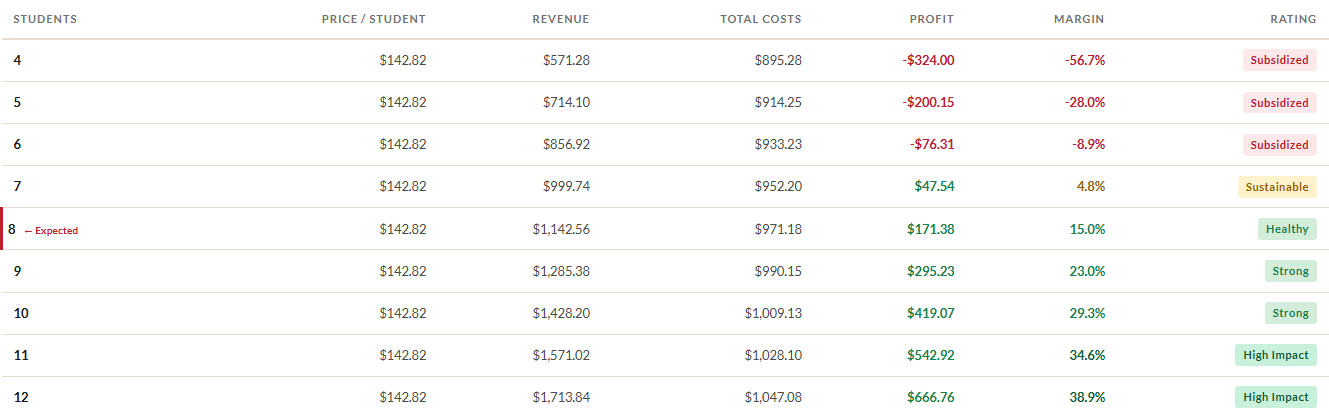
The approach we've landed on at Lander is to set the price based on a realistic minimum enrollment, then treat additional students as upside. If your ceramics studio comfortably holds 10 students and you reliably fill to 8, pricing at the 8-student level ($132) is a defensible choice. If all 10 spots fill, your margin improves. If you only get 7, you're close to break-even but not underwater.
Your break-even point is the enrollment level where revenue exactly covers buffered costs with zero margin. For this class at $111/student, break-even is about 8 students. Below 8, you lose money at that price.
Step 5: Consider Tiered Pricing
If you teach in a community setting, you've probably wrestled with the question of affordability. You want your classes to be accessible, but you also need them to be financially sustainable. Tiered pricing (sometimes called sliding-scale pricing) lets you do both.
The model we use at Lander Art Center has three tiers:
- Supported: A reduced rate for students who need financial assistance. This is your floor: the minimum per-student price at which you can still cover costs if a meaningful portion of the class enrolls at this level.
- Standard: The full calculated price. This is what most students pay and what your budget is built around.
- Supporter: A premium rate for students who want to subsidize the Supported tier. This is typically 15-30% above the Standard price.
For our wheel-throwing class at $111 Standard, a tiered structure might look like this:
- Supported: $94 (15% below Standard)
- Standard: $111
- Supporter: $133 (20% above Standard)

You'll notice the tiers aren't symmetrical, and that's on purpose. In practice, more students will choose the Supported tier than the Supporter tier. That's just human nature. By keeping the discount smaller (15%) and the premium larger (20%), you're not trying to make any single class perfectly balance out. You're looking out for the overall health of your class ecosystem across an entire year of programming. Some classes will skew Supported-heavy, others will land mostly at Standard, and over time the math smooths out.
For a deeper dive into why sliding scale works and how to plan your tier strategy before you open the calculator, see Sliding Scale Pricing for Classes.
Set your Supported floor with care. It should never go below your break-even cost per student at minimum enrollment. If your break-even at 8 students is around $112 per student, your Supported price should stay close to or above that level unless you have grant funding or other contributed income to cover the gap. Class Price Calculator has this safeguard built in: the Supported tier is automatically floored at your break-even cost per student, so nobody has to remember to check it.
Putting It All Together
Here's the recap for our 6-session wheel-throwing class:
- True costs: $772.80 (instructor at 3.5 hrs/session including setup and cleanup, materials, coordinator, overhead)
- Buffered costs: $941.16 (with 25/15/20% risk buffers)
- Revenue target at 15% margin: $1,107.25
- Per-student price at 10 students: $111
- Tiered pricing: $94 / $111 / $133
That $111 is not a guess. It's not what another studio charges. It's not a number you picked because it "felt right." It's a price built on your actual costs, adjusted for real-world risk, with a margin that keeps your program running next season too.
You can do this math by hand or in a spreadsheet. The moment you want to adjust one variable (what if the instructor rate goes up to $25? or $50? or $100? what if we add a 7th session? what if enrollment caps at 8?), you're redoing the entire calculation. If you want to compare three versions of the class side by side, the spreadsheet gets unwieldy fast.
We built Class Price Calculator to handle that variable-juggling for our own program. It's the same tool linked at the bottom of this article.
The Hidden Costs Teaching Artists Forget
Even a thorough cost breakdown can miss expenses that don't show up on a per-class basis but quietly eat into your earnings over time. The most common ones we've watched bleed margin out of programs are payment processing fees (a 3-6% cut from the credit card platform, which on a $111 fee means $3-7 per student you never see), the marketing hours that go into class descriptions and social posts and flyer design, gas and mileage if you're teaching across multiple venues, and the prototype piece you usually have to make yourself before you can teach the project to anyone else. None of those show up on the receipt.
Then there are the small recurring supplies that disappear faster than anyone thinks to budget for. Tape, paper towels, aprons, drop cloths, plastic cups for rinse water. And professional development: the workshop you took last year to keep your own practice sharp is part of why students sign up for your class.
You don't need to add each of these as a separate line item in every pricing exercise. Knowing they exist helps you understand why your margin isn't "extra." It's covering the real cost of being a working teaching artist.
TL;DR: The Five-Step Framework
If you scrolled straight here, no judgment. Here's the quick version:
- Add up your real costs. Instructor time (including setup and cleanup!), materials, coordinator hours, and facility overhead.
- Add risk buffers. 20-40% on instructor, 10-20% on materials, 15-30% on coordinator. Things always cost more than you plan.
- Set a margin. In our experience 10-20% gross margin works for community classes. Divide your buffered costs by (1 minus your margin percentage).
- Model enrollment scenarios. Your price per student changes dramatically at 6 vs. 8 vs. 12 students. Know where your break-even is.
- Consider tiered pricing. A Supported/Standard/Supporter model lets you stay accessible without losing money.
For our example (6-session ceramics, $20/hr instructor, 10 students), the math landed at $111/student with a 15% margin. The full walkthrough above shows you exactly how we got there.
Skip the Spreadsheet
Class Price Calculator does all five steps automatically. Enter your costs, set your buffers, and see pricing at every enrollment level instantly. Pay what you want, starting at $0.
Try Class Price CalculatorFrequently Asked Questions
How much should I charge per student for an art class?
It depends on your cost structure. In our experience pricing classes at Lander Art Center and the centers we trade notes with, per-student prices for a multi-session class (4-8 sessions) tend to land between $80 and $200. Calculate your actual costs, including setup and cleanup time, materials, coordination, and overhead, rather than guessing based on what others charge.
Should I include materials in my class fee?
In most cases, yes. Including materials simplifies registration, ensures consistent quality, and prevents students from showing up with incompatible supplies. Price materials at retail cost to students, but source them at wholesale to build in a small margin.
What profit margin should I target for art classes?
In our experience, 10-20% gross margin is common and sustainable for community education. This means if your total costs are $940, your total revenue target should be about $1,045 to $1,175. Higher margins (20-30%) are appropriate for specialized workshops or private instruction.
Do I need a separate pricing worksheet?
No. The five-step framework in this article IS your worksheet: costs, buffers, margin, enrollment scenarios, and tiered pricing. If you want to skip the manual math, Class Price Calculator automates every step.