If you teach classes regularly, you've probably got your pricing dialed in (or at least close enough). But workshops? Workshops are a different animal. We've run plenty of them at the Lander Art Center, and we've learned the hard way that you can't just scale your weekly class math up or down and call it good.
What you should charge comes down to four things: your total costs (teaching time, materials, venue, coordination), how many participants you expect, what margin you need to keep doing this work, and how price-sensitive your audience is. None of this requires guesswork.
One thing about workshops worth saying up front: the stakes are compressed. A weekly pottery class gives you room to recover from a low-enrollment week. A Saturday workshop doesn't. One bad enrollment number can turn a profitable event into an expensive lesson in why you should have modeled the numbers first. We've spent that money. We'd rather you didn't.
Workshop Pricing Is Different from Class Pricing
If you already teach recurring classes, you've got built-in advantages that workshops don't offer. A weekly class spreads your fixed costs across many sessions. If enrollment dips one week, you recover the next. You know your regulars, you can predict attendance, and you have time to adjust.
Workshops flip all of that. They're one-off or short-run events. The costs hit all at once. Material expenses per student tend to be higher because you're cramming more learning into less time, which usually means more supplies. You may be renting a venue you don't normally use. You might be traveling. And the risk is concentrated: one under-enrolled workshop can wipe out a month of income if you haven't priced it right.
The upside is real, though. Workshops command higher per-hour pricing than recurring classes because participants see them as special events. A student who balks at $40/week for a pottery class will happily pay $185 for a Saturday intensive that covers the same material. The framing matters. But only if your pricing actually covers your costs and leaves you something on the other side.
The Four Cost Layers
Every workshop price should be built from four cost layers. Skip one and you'll be wondering where your profit went. (We've done it. No judgment.)
This follows the same cost framework we cover in How to Price Art Classes, adapted for workshop formats.
1. Teaching Time
Your hourly rate times your total hours. And total hours means more than face time. If you're teaching a 4-hour workshop, you're probably spending 2-3 hours on prep: writing the curriculum, building demos, preparing examples, setting up the room. Count all of it.
2. Materials
Workshop materials tend to cost more per student than ongoing class materials because you're front-loading everything. A mosaics workshop might run $30 to $80 per student in supplies. A ceramics workshop where everyone throws multiple pieces and you handle firing? Could be even higher. Source at wholesale whenever possible, and charge at or near retail in your per-student price. The difference is part of your margin, and it's entirely reasonable. You're doing the sourcing, the hauling, and the organizing.
If you want to itemize materials for a class proposal or just see how cost-per-head scales with enrollment, our Workshop Material Cost Calculator builds the line items and prints a clean summary. For ceramics workshops where you handle firing, the Kiln Firing Cost Calculator will give you a per-firing number to add into the materials line.
3. Venue and Facility
If you're teaching in your own studio, you still have facility costs (utilities, insurance, wear, cleanup), but they're probably modest. If you're renting space, you're looking at a flat fee, a percentage of revenue, or both. Community centers might charge $100-300 for a day. A gallery or co-working space could be more. And don't forget setup and teardown time when calculating your venue costs. If you need an extra hour on each end, that's real time.
4. Coordination and Admin
Someone has to handle registration, answer emails, send reminders, manage the waitlist, and deal with day-of logistics. If that someone is you, you're still spending time on it (and your time isn't free, even when it feels like it should be). Coordination for a typical workshop runs 2 to 6 hours. For a simple half-day event with online registration, it might be 2 hours. For a weekend intensive with custom supply kits, lodging logistics, and dietary accommodations? Easily 6 or more.
Three Workshop Scenarios
Enough theory. Let's put real numbers to three common workshop formats. For each one, we'll calculate total costs, the per-student break-even price, and a recommended price with a 15% margin built in.
Scenario A: Half-Day Painting Workshop
Four hours of instruction, 12 participants, no venue fee (your own studio).
| Cost Category | Calculation | Amount |
|---|---|---|
| Teaching time | 6 hrs (4 teaching + 2 prep) × $45/hr | $270 |
| Materials | 12 students × $25/student | $300 |
| Venue | Own studio | $0 |
| Coordination | 2 hrs × $18/hr | $36 |
| Total costs | $606 | |
| Break-even per student | $606 ÷ 12 | $50.50 |
| Recommended price (15% margin) | $50.50 × 1.15 | $58 |
Scenario B: Weekend Pottery Intensive
Two days, 6 hours per day, 8 participants, rented studio space.
| Cost Category | Calculation | Amount |
|---|---|---|
| Teaching time | 16 hrs (12 teaching + 4 prep) × $55/hr | $880 |
| Materials | 8 students × $65/student | $520 |
| Venue | 2-day studio rental | $500 |
| Coordination | 4 hrs × $35/hr | $140 |
| Total costs | $2,040 | |
| Break-even per student | $2,040 ÷ 8 | $255 |
| Recommended price (15% margin) | $255 × 1.15 | $294 |
Scenario C: Multi-Session Drawing Series
Six sessions of 2 hours each, 10 participants, facility takes 15% of revenue.
| Cost Category | Calculation | Amount |
|---|---|---|
| Teaching time | 18 hrs (12 teaching + 6 prep) × $50/hr | $900 |
| Materials | 10 students × $15/student | $150 |
| Venue | 15% of revenue (calculated after) | see below |
| Coordination | 5 hrs × $30/hr | $150 |
| Pre-venue costs | $1,200 |
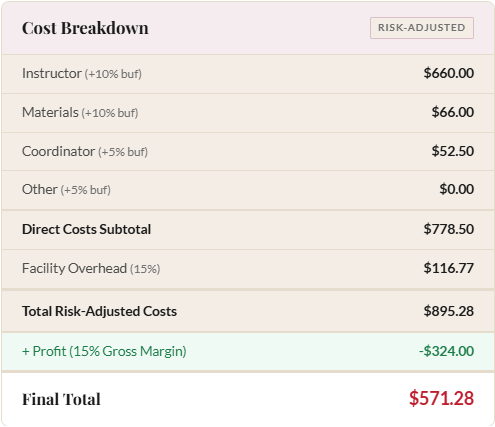
When the venue takes a percentage of revenue, you need to work backward. Your pre-venue costs are $1,200. With 10 students and a 15% margin target, you need revenue that covers $1,200 in costs, the 15% venue cut, and your 15% margin. The formula: $1,200 ÷ (1 - 0.15 venue - 0.15 margin) = $1,200 ÷ 0.70 = $1,714 total revenue, or about $172 per student. The venue gets $257, you keep $1,457, and your margin after all costs is roughly $257.
The Enrollment Risk Question
OK, here's where workshop pricing gets uncomfortable. All three scenarios above assume full enrollment. But what happens when only half the seats fill?
Let's take Scenario A, the half-day painting workshop, and model it at three enrollment levels. Your fixed costs (teaching, coordination) stay at $306 regardless of headcount. Only materials scale with enrollment.
| Enrollment | Fixed Costs | Materials | Total Cost | Break-Even Price | Price at 15% Margin |
|---|---|---|---|---|---|
| 12 students | $306 | $300 | $606 | $50.50 | $58 |
| 8 students | $306 | $200 | $506 | $63.25 | $73 |
| 5 students | $306 | $125 | $431 | $86.20 | $100 |
Look at the spread. At full enrollment, you can charge $58 and hit your margin. At 5 students, you'd need to charge $100 just to break even with margin. If you set your price at $58 and only 5 people show up, you're collecting $290 against $431 in costs. That's a $141 loss on your Saturday.
The question isn't "what should I charge?" in isolation. It's "what should I charge given the most likely enrollment, and what's my plan if enrollment comes in low?"
This is exactly why scenario modeling matters. You need to see the per-student price at every enrollment level, from your minimum to your maximum, before you commit to a number. Picking a price based only on full enrollment is wishful thinking, and wishful thinking is how workshops lose money.
Setting Your Minimum to Run
Every workshop should have a minimum-to-run number, and you should set it before you start marketing. Here's how we think about it:
- Calculate your break-even enrollment. What's the fewest number of students at which your revenue covers your costs? In Scenario A at $75/person, that's $606 ÷ $75 = 8.1, so 9 students to break even.
- Add a buffer of 1-2 students. Your minimum to run should be 10 or 11, not 9. The buffer is your margin. Without it, you're working for free at the minimum.
- Set a decision date. Pick a date 5-7 days before the workshop. If you haven't hit your minimum by then, cancel or reschedule. Communicate this date in your registration materials.
- Tell your registrants. Something like "This workshop requires a minimum of 10 participants. We'll confirm by [date] or offer a full refund" works great. It's not awkward. People get it.
Canceling a workshop that won't break even isn't a failure. Running one at a loss because you didn't set a minimum is.
Don't Forget the Hidden Costs
After you've tallied your four cost layers, run through this checklist. These are the costs that instructors forget most often (we know because we've forgotten them too), and they can easily add $50-150 to your total.
- Prep time beyond curriculum writing. Did you make a sample piece? Test a technique? That's teaching time you should be counting.
- Prototype and sample materials. The supplies you used to build your demo or test a project aren't free. Add them to your materials cost.
- Marketing time. If you spent 3 hours writing the listing, creating social posts, and emailing your list, that's coordination time at your admin rate.
- Payment processing fees. Gumroad takes approximately 5%. Eventbrite takes approximately 6% plus per-ticket fees. Square charges 2.6% + $0.10. If you use a class registration platform like CourseStorm, expect roughly 4% plus a $2.49 per-registration fee on top of standard credit card processing. These all come off the top of every payment you receive, so factor them into your pricing.
- Consumable supplies you didn't itemize. Tape, paper towels, drop cloths, cleaning supplies, hand soap, trash bags. They add up, especially for messy media. (Ask us about our watercolor workshop paper towel budget sometime.)
- Insurance. If your workshop involves tools, chemicals, or physical activity, you may need event insurance. A one-day policy can run $75-200.
- Travel and parking. If you're driving supplies to a rented venue, count your mileage and parking. IRS standard mileage rate is $0.70/mile in 2026.
A good rule of thumb: after you calculate your total costs, add 10-15% as a miscellaneous buffer. If your costs come to $800, budget for $880-920. Trust us, you'll use it.
That's a Lot of Math. Let Us Handle It.
Whether you're pricing a Saturday afternoon workshop or a multi-session intensive, Class Price Calculator does all of this automatically. Enter your costs, set your enrollment range, and see every scenario instantly. No spreadsheets, no formulas, no forgetting the paper towels.
Try Class Price CalculatorFrequently Asked Questions
How much should I charge for a 3-hour workshop?
For a 3-hour workshop with materials included, in our experience and from peers we trade notes with, most instructors charge $65 to $150 per participant depending on materials cost, class size, and location. Calculate your actual costs (teaching time + materials + venue + admin), add a 15-20% buffer, add your target margin, and divide by expected enrollment.
Should I charge more for a weekend workshop?
Yes. Multi-day workshops carry higher costs (extended venue rental, more materials, meals or refreshments) and higher value to participants. In our experience, weekend intensive pricing runs $200 to $500 per participant for arts learning workshops.
What's the minimum number of participants I should require?
Set your minimum at your break-even enrollment plus 1-2 students. If your costs are $900 and you're charging $120/person, your break-even is 8 students, so set your minimum to run at 9 or 10. Communicate this minimum in your registration materials so students know the policy.