If you've ever set a class price and immediately thought, "but what about the people who can't afford that?", you're not alone. We've been there. At the Lander Art Center, we wanted our classes open to everyone in our community, but we also needed to pay our instructors and keep the kiln running.
Sliding scale pricing is how we squared that circle. You give students multiple price points for the same class. A three-tier model (Supported, Standard, and Supporter) lets people on limited income participate while students who can pay a bit more help cover the gap. Nobody loses money. Nobody gets left out. It's one of the best tools we've found for building programs that are both inclusive and solvent.
This guide walks through the exact model we use, the math behind it, and the practical decisions that make it work for art classes, workshops, and community education programs.
Honest concession before we get into the math: the first time we ran sliding scale at Lander, we set our Supported tier 22% below Standard because that "felt accessible." It was below break-even. We didn't catch it until the post-class review. The break-even floor section below is the rule we wish we'd written down before that class, not after.
Why Sliding Scale Pricing Matters in Community Education
Running a community art center is a constant negotiation between mission and budget. Mission says "serve everyone." Budget says "cover costs." Those can feel like they're pulling in opposite directions, but they don't have to be.
In our experience, 15-30% of potential students would benefit from reduced pricing. These are people who want to take your watercolor workshop or your ceramics series but can't swing the full rate. Maybe they're between jobs. Maybe they're retired on a fixed income. Maybe they're a young artist putting every spare dollar into supplies. The reasons vary; the need is consistent.
Without a structured model, you end up making ad hoc decisions: offering a discount here, waiving a fee there, with no clear picture of how it all affects your bottom line. Sliding scale pricing replaces that guesswork with a system. You decide in advance what you can afford to offer, set guardrails so you never dip below break-even, and give students the dignity of choosing a tier that fits their situation, without awkward conversations.
The result is a pricing model that serves more people without quietly bleeding your program dry.
The Three-Tier Model
The most effective sliding scale systems are simple. Three tiers is the sweet spot: enough to create real accessibility, few enough that students aren't overwhelmed by choices. Here's how each one works.
Supported (Reduced Price)
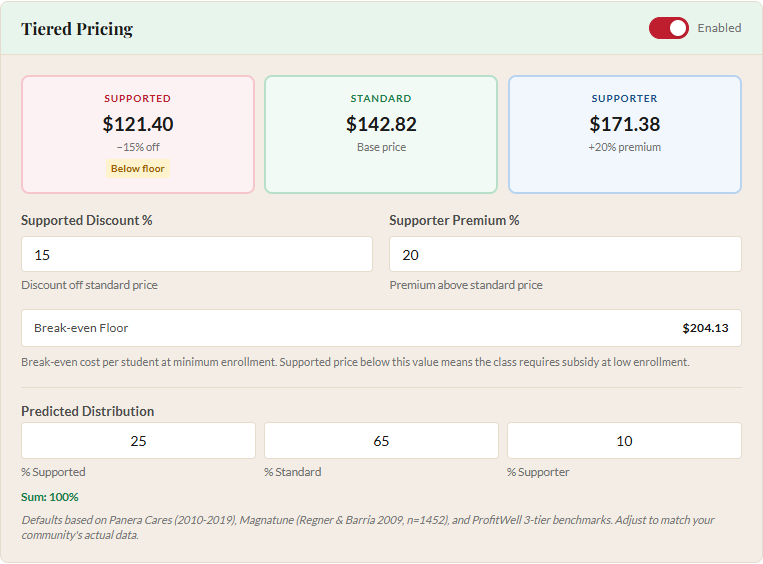
This is your accessibility tier. Students in a tight financial season choose this option. The discount typically ranges from 10% to 15% off the Standard price, but the critical rule is this: the Supported price can never drop below your per-student break-even cost. That's your floor. It's the price at which you cover costs and nothing more. Go below it and you're losing money on every discounted seat.
For a class where the Standard price is $225 per student and your break-even cost is $191 per student, the Supported price would be $191. That's a 15% discount. It's meaningful for the student and safe for your budget.
Standard (Base Price)
This is your full calculated price, based on your actual costs plus a healthy margin. It accounts for instructor pay, materials, facility costs, administrative overhead, and whatever buffer you've built in. Most students (typically around 50%) will pay this tier. It's not inflated. It's not discounted. It's the real price of delivering your class well.
In our running example, Standard is $225 per student.
Supporter (Premium Price)
This tier is for students who can and want to pay more, knowing their extra contribution directly funds accessibility for others. A 15-20% premium is typical. You're not overcharging. You're inviting generosity from people who have the capacity for it.
At a 20% premium on our $225 Standard price, the Supporter tier comes to $270 per student. That extra $45 per Supporter seat helps offset every Supported seat in the room.
Here is a quick summary of the three tiers:
| Tier | Price | Adjustment | Who It Serves |
|---|---|---|---|
| Supported | $191 | 15% off (floored at break-even) | Students in a tight financial season |
| Standard | $225 | Base price | Most students |
| Supporter | $270 | 20% premium | Students who want to fund accessibility |
Setting the Break-Even Floor
The break-even floor is the single most important number in your sliding scale model. It's the safety net that keeps generosity from turning into financial harm.
Calculating it is straightforward: take your total costs at minimum enrollment and divide by the number of students.
Break-even price = Total costs at minimum enrollment ÷ Minimum number of students
Here is a real example. Say you're teaching a six-session pottery class. Your costs look like this:
- Instructor pay: $600 (6 sessions × $100/session)
- Materials per student: $35 (clay, glazes, firing)
- Facility/kiln costs: $180
- Administrative overhead: $156
Your minimum enrollment is 6 students. At that enrollment, total costs are:
$600 + ($35 × 6) + $180 + $156 = $1,146
Break-even per student: $1,146 ÷ 6 = $191
This means your Supported tier can never go below $191. If your Standard price is $225, the maximum discount you can offer is $34, or about 15%. The math sets that discount, not a gut feeling about what seems generous.
If your Standard price were lower (say $210), the maximum safe discount shrinks to about 9%. And that's fine. A smaller discount is infinitely better than a discount that puts you underwater.
The Math: Will Tiers Actually Work for You?
This is the question that keeps educators up at night. If you offer reduced pricing, will you lose revenue? Here are the numbers from a realistic scenario.
Assume you have a class with 10 students at the three tiers described above. In our experience, a reasonable distribution looks like this:
| Tier | Students | Price | Revenue |
|---|---|---|---|
| Supported (30%) | 3 | $191 | $573 |
| Standard (50%) | 5 | $225 | $1,125 |
| Supporter (20%) | 2 | $270 | $540 |
| Total (tiered) | 10 | $2,238 | |
| Total (all Standard) | 10 | $225 | $2,250 |
The blended revenue with tiered pricing is $2,238, just $12 less than if every student had paid the Standard price. That's a difference of 0.5%.
And here's what the spreadsheet doesn't capture: those three Supported students might not have enrolled at all without the reduced price. If even one of them would have stayed home, your actual revenue without sliding scale drops to $2,025 (9 students at $225). The tiered model with 10 students beats the flat model with 9 students by over $200.
Supporter premiums offset Supported discounts. Your total revenue stays remarkably close to the flat-rate scenario, and you fill more seats.
And the math shifts even further in your favor if Supporter uptake exceeds 20%. In our experience, Supporter rates can rise to 30-35% once students understand that their premium directly funds community access.

Common Mistakes with Sliding Scale Pricing
Sliding scale pricing isn't complicated, but there are a few mistakes that can undermine the whole system. Here are the ones we see most often.
Setting the Supported price below break-even
This is the most dangerous mistake. If your break-even cost is $191 per student and you set your Supported price at $175 because it "feels more accessible," you're losing $16 on every discounted seat. With three Supported students, that's $48 out of your margin per class. Over a year of programming, it adds up to hundreds or thousands of dollars in losses that are invisible until your budget review.
The fix: Always calculate break-even first, then set your discount as the gap between Standard and break-even. Never the other way around.
Making the discount too aggressive
Discounts above 25% rarely work in community education unless your margins are unusually high. A 30% discount on a $225 class brings the Supported price to $157.50, well below our $191 break-even floor. The deeper the discount, the more Supporter seats you need to compensate. The math gets fragile fast.
The fix: Keep Supported discounts in the 10-15% range. If you need to offer deeper accessibility, consider a separate scholarship fund rather than baking it into the tier structure.
Using generic tier names
Labels like "Tier 1," "Tier 2," and "Tier 3" tell students nothing about intent. They feel transactional. Names like Supported, Standard, and Supporter carry meaning. "Supported" says "you're being held by your community." "Supporter" says "your generosity makes this possible." Language shapes how people relate to the system, and we've seen firsthand how much the right words matter.
Requiring income verification
Some organizations ask students to prove financial need before accessing the Supported tier: pay stubs, tax returns, benefit letters. This approach kills enrollment. It creates friction, it signals that you don't trust your community, and it puts an emotional burden on people who are already in a vulnerable position.
The fix: Use a trust-based system. Describe each tier clearly, state the purpose, and let students self-select. The vast majority of people choose honestly. The occasional person who picks Supported when they could afford Standard? That's not a problem worth solving with paperwork.
How to Communicate Tiers to Students
The way you present your tiers matters as much as the prices themselves. We've tried a few different approaches, and here's what works:
Lead with mission, not with the discount. Instead of "Get 15% off!" try: "We offer three pricing tiers so everyone in our community can participate. Pick the one that fits your season." The frame is belonging, not bargain-hunting.
Describe each tier in one sentence. Keep it human and direct:
- Supported ($191): "For those in a tight financial season. No application, no questions asked."
- Standard ($225): "Our base price, covering the full cost of the class."
- Supporter ($270): "For those who can give a little more, helping fund access for others."
Don't require justification. A trust-based model means trusting your community. No dropdown asking "Why are you choosing this tier?" and no follow-up email. Honor that in every interaction.
Make Supporter feel like an invitation, not a guilt trip. People respond to purpose, not pressure. "Your extra $45 helps someone else take this class" is an invitation. "Please consider paying more" is a guilt trip. The difference is subtle but it matters.
When the framing lands, students stop seeing sliding scale as charity and start seeing it as community. Supporters feel good about contributing. Supported students feel welcomed. Your program stays financially healthy while serving more people than a single-price model ever could.
Build Your Tiers in Minutes
Class Price Calculator automatically generates Supported, Standard, and Supporter pricing with configurable discounts, premiums, and a break-even floor that guarantees you never lose money on a discounted seat.
Try Class Price CalculatorFrequently Asked Questions
What percentage discount should I offer for sliding scale?
A 10-15% discount for the Supported tier works well for most classes. Go above 25% and you risk operating at a loss unless your Supporter tier compensates significantly. The key constraint: never price below your per-student break-even cost.
Do I need to verify students' income for sliding scale?
No. Trust-based sliding scale systems consistently outperform verification-based ones. Requiring proof of income creates friction, deters enrollment, and signals distrust. In our experience, students self-select honestly when tiers are clearly described.
How does tiered pricing affect total revenue?
In our experience at Lander, with a 30% Supported / 50% Standard / 20% Supporter distribution, blended revenue lands within 2-5% of what we would have earned at a flat Standard price. The Supporter premium largely offsets the Supported discount.