If you're running classes at a nonprofit, you already know the juggling act: cover your real costs, keep things accessible for your community, and be ready to justify every number when someone asks. It's a lot. We get it. We've been doing the same thing at the Lander Art Center for years.
Whether you're at an arts education nonprofit, a community learning center, or a workforce development program, the core challenge is the same. You need pricing you can stand behind, pricing that's honest about what things cost, and a plan for keeping your doors open to people who need you.
One thing to name upfront: the first three years we ran printmaking classes at Lander, we priced them at break-even or slightly under because we didn't want to seem expensive to the local community. We thought we were being generous. We were actually losing money on every section, and our paid instructors were quietly noting that their hours kept getting capped. The framework below is what we use now. We learned it the slow way.
The Nonprofit Pricing Tension
Every program director knows the bind in their bones: mission says "serve everyone," budget says "cover costs," and those two feel like they're pulling in opposite directions. The instinct (a generous one) is to just underprice everything. Set fees low enough that nobody complains, absorb the shortfall somewhere, and hope for the best.
Spoiler: it doesn't work out. Chronic underpricing is one of the biggest reasons community education nonprofits end up cutting programs, losing instructors, and burning out staff. When classes consistently lose money, you end up subsidizing them with contributed income that was meant for other things. Instructors notice when raises never come. Program directors burn out trying to stretch less into more every single semester.
The solution isn't to charge more or less. It's to know your actual numbers so you can make informed decisions about pricing, accessibility, and sustainability.
When you know your true costs, you can have honest conversations with anyone who has a stake in the outcome. You can explain why a class costs what it costs, how sliding-scale pricing actually gets funded, and what enrollment targets you need to hit. That kind of transparency builds trust. And trust is everything when you're a nonprofit.
Building Cost-Based Pricing (What Decision-Makers Want to See)
Anyone reviewing your pricing wants to know the same thing: what does this class actually cost to deliver? Not what you hope it costs. Not what it cost three years ago. What it costs right now, with every real expense on the table.
If you're new to cost-based class pricing, start with How to Price Art Classes for the foundational framework. Below, we adapt those principles for the nonprofit context.
Here's a worked example from one of our own programs: a 6-week printmaking class, meeting once a week for 2.5 hours per session.
Direct Instructor Costs
This is your instructor's contracted rate, not a staff salary (that gets accounted for differently). If your instructor is paid $25/hour for a 2.5-hour session over 6 weeks, that's $375. Since it's a contracted fee, you're not paying benefits or payroll taxes on top of it. If your instructors are W-2 employees, you'll need to factor in the loaded cost (salary plus benefits plus employer-side taxes), which can add 25-35% on top of the base rate.
Materials and Supplies
Some materials are per-student (ink, paper, printing plates), and some are shared (brayers, press maintenance, cleanup supplies). For our printmaking class, estimate $18 per student in consumable materials plus $40 in shared supplies regardless of class size. At 10 students, that's $220 total.
For a defensible per-student materials line on a board report or grant budget, our Workshop Material Cost Calculator itemizes every supply with a waste buffer and prints a one-page summary. If your program runs ceramics, the Kiln Firing Cost Calculator will let you defend firing as a real direct cost rather than burying it in overhead.
Coordinator and Staff Time
This is the cost that nonprofits undercount the most. Somebody is managing registration, emailing the instructor, ordering supplies, handling day-of logistics, and processing payments. If your program coordinator earns $18/hour and spends 8 hours total on this class across the semester, that's $144 in staff time. It's real work. Count it.
Facility Allocation
Your building costs money whether or not a class is running in it. But this class is using the space, and that use has a cost. A common approach: take your total annual facility costs (rent or mortgage, utilities, maintenance, insurance) and allocate a slice to each program based on hours of use. For a class using a studio 15 hours over 6 weeks, you might allocate $180.
Administrative Overhead
Bookkeeping, insurance, marketing, tech costs. All the behind-the-scenes stuff that makes the class possible in the first place. In our experience, applying an overhead rate of 15-25% of direct costs to each program is a defensible approach. For this class, a 15% overhead rate adds roughly $138.
Here's what it all looks like together:
| Cost Category | Amount | Notes |
|---|---|---|
| Instructor (contracted) | $375 | $25/hr × 2.5 hrs × 6 weeks |
| Materials & supplies | $220 | $18/student × 10 + $40 shared |
| Coordinator time | $144 | 8 hrs × $18/hr |
| Facility allocation | $180 | Based on studio hours used |
| Administrative overhead | $138 | 15% of direct costs |
| Total cost to deliver | $1,057 | At 10 students: $106/student |
That's your baseline. At 10 students, this class costs $106 per student to deliver. Any price below that means you're subsidizing it with contributed income. That can be a perfectly valid choice, but it should be a conscious one. Not an accident you discover in April.
Setting Your Margin (Yes, Nonprofits Need Margin)
This is where a lot of nonprofit leaders get uncomfortable. "We're a nonprofit. We're not supposed to make a profit." We hear you, and no judgment, but margin isn't profit. Margin is organizational resilience. It's the difference between weathering a slow enrollment semester and having to cancel programs and let staff go.
A healthy margin covers the stuff that keeps your organization alive between semesters:
- Unexpected maintenance: the kiln breaks, the roof leaks, the registration system needs an upgrade (we're doing this right now!)
- Staff professional development: your team needs training, conferences, and growth opportunities to stay effective
- Program development: designing next semester's classes takes time and money before any revenue comes in
- A rainy-day fund for the inevitable semester when enrollment dips and you need to keep the lights on
In our experience, a 10-15% margin is standard in nonprofit education, and it's completely defensible to anyone reviewing your numbers. At 15% margin on our printmaking class, the per-student price moves from $106 (cost) to roughly $125 (cost + margin). That extra $19 per student isn't going into anyone's pocket. It's going into your organization's ability to still be here next year.
Enrollment Scenarios: The Decision-Ready Table
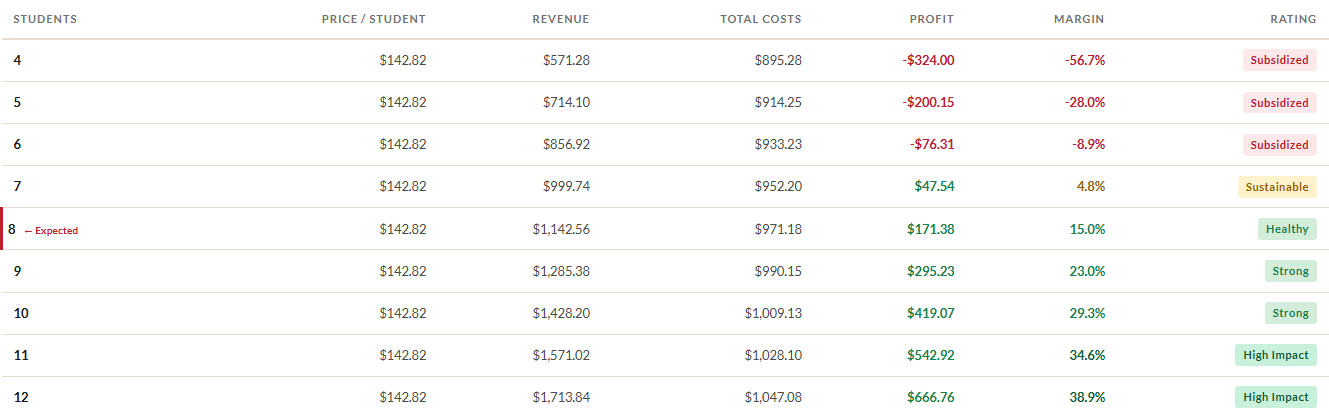
OK, this is where it gets really useful. Instead of guessing whether a class will "work" financially, you can model exactly what happens at different enrollment levels. This is the table you bring to your next meeting.
Using our printmaking class at $120 per student (a round number between cost and full margin):
| Students | Revenue | Total Cost | Surplus | Margin |
|---|---|---|---|---|
| 6 | $720 | $974 | -$254 | -35.3% |
| 8 | $960 | $1,015 | -$55 | -5.7% |
| 10 | $1,200 | $1,057 | +$143 | 11.9% |
| 12 | $1,440 | $1,098 | +$342 | 23.7% |
The story jumps right off the page: at 6 students, this class loses $254. At 8 students, it's still a small loss. At 10 students, it's contributing meaningfully to organizational sustainability. Your break-even point lands right around 9 students.
This is the conversation your organization actually wants to have. Not "should we charge $100 or $150?" but "what's our minimum enrollment, and what's our plan to hit it?" That's a strategic conversation, not a guessing game.
Accessibility Without Subsidizing at a Loss
Let's be clear: mission-driven pricing doesn't mean losing money on every class. It means building a pricing structure that intentionally funds accessibility. And tiered pricing is the most effective way we've found to do that.
The Three-Tier Model
- Supported tier ($102): Below cost, funded by the surplus generated from Supporter-tier registrations and, where available, dedicated scholarship funds. This is for community members who genuinely cannot afford the standard rate.
- Standard tier ($120): Covers actual costs plus your sustainability margin. This is what the class costs to deliver, honestly and transparently.
- Supporter tier ($144): A premium tier where participants choose to pay above cost. The difference directly funds Supported-tier access for others.
What makes the Supporter tier work is framing. Don't present it as a surcharge or an upsell. Present it as a community investment:
Your $144 pays for your class AND helps fund a seat for a neighbor who can't afford the full price. Every Supporter registration directly subsidizes one Supported-rate seat.
In our experience, 20-30% of registrants will choose the Supporter tier when the framing is clear and the impact is concrete. That's enough to fund 2-3 Supported-rate seats in a class of 10-12 students. Real accessibility, no net loss to the organization.

Grant Alignment
If your programming is partially grant-funded (and whose isn't?), your pricing strategy and your grant narrative need to tell the same story. Most funders expect earned revenue to cover a specific percentage of program costs, and they want to see your math.
A cost-based pricing model gives you exactly what you need for grant applications and reports. You can show that your fee structure covers, say, 75% of direct program costs, with the remaining 25% covered by contributed income (grants, individual giving, fundraising events). That's a strong narrative because it tells the funder three things:
- You know your real costs. You're not guessing or rounding. You can show the line items.
- You're not fully dependent on contributed income. Earned revenue is carrying the majority of the load, which signals sustainability.
- Their investment has a multiplier effect. A $5,000 grant doesn't just fund one class. It funds the accessibility gap across an entire semester of programming, enabling 20+ reduced-rate registrations.
When you can drop an enrollment scenario table into your grant report showing earned revenue projections alongside your contributed income needs, you're giving program officers exactly the data they use to make funding decisions. It moves your application from "we do good work and need money" to "here's the financial model, here's the gap, here's what your investment makes possible."
Making the Case to Decision-Makers
Whether you're a program director presenting to leadership, a teaching artist proposing a workshop to the organization that would host it, or an independent instructor justifying your rates to a venue, the conversation about pricing tends to go one of two ways. Either someone says "that seems expensive" and the discussion spirals into feelings and anecdotes, or someone shows up with clear numbers and the conversation focuses on strategy. You definitely want the second one.
Here's a framework that works no matter who's on the other side of the table:
- Present the cost breakdown. Show every line item. Let decision-makers see that the number isn't arbitrary but the sum of real, identifiable expenses. When the person reviewing your pricing can see that $375 of a $120 class fee goes directly to the instructor, the conversation changes.
- Show the enrollment scenario table. Decision-makers are often thinking about risk. They understand break-even analysis. When they can see that 8 students is the break-even point and you're averaging 11, they feel confident. When they see you're averaging 7, they understand the problem and can help solve it.
- Explain the tiered pricing model. Show how Supporter-tier revenue funds Supported-tier access. Quantify the impact: "At current enrollment, 4 students per class receive reduced-rate access, funded entirely by voluntary Supporter-tier registrations." That's a mission impact metric that gets people excited.
- Connect pricing to the budget. Show how class revenue fits into the organization's overall financial picture. If classes generate 60% of your earned revenue and cover 75% of their own costs, that's a story about an organization with a sustainable model.
Decision-makers love data, so give them data. When every number in your pricing traces back to a real cost, the question stops being "are we charging too much?" and starts being "how do we make sure enrollment hits our targets?" That's a much better question, and it's one that whoever is at the table can actually help you answer.
Decision-Ready Pricing in Minutes
We built Class Price Calculator because we needed it ourselves. It generates the cost breakdowns, enrollment scenarios, and tiered pricing tables that decision-makers want to see.
Try Class Price CalculatorFrequently Asked Questions
How do nonprofits determine class pricing?
Start with your actual costs: instructor fees, materials, staff time, and facility overhead. Add a 10-15% margin for organizational sustainability (in our experience, this is standard and expected by funders). Then model pricing at different enrollment levels to find the break-even point. Finally, consider tiered pricing to balance accessibility with financial sustainability.
Should nonprofits charge for classes?
Yes. Earned revenue from class fees is a big part of staying financially sustainable for most arts education nonprofits. Underpricing leads to program cuts and staff burnout. Price based on actual costs rather than guesswork, and offer sliding-scale options for community members who need them.
How do I justify class prices to decision-makers?
Present a cost breakdown showing every expense line item, an enrollment scenario table showing revenue and surplus at different class sizes, and your break-even point. When decision-makers can see that a $120/student fee covers $106 in actual costs plus $14 in organizational sustainability margin, the conversation shifts from "are we charging too much?" to "how do we ensure enrollment hits our targets?"